How To Spot Fake Pokémon Cards
A detailed guide for identifying counterfeit Pokémon Trading Card Game cards in English, Japanese and Korean, including individual cards, modern textured cards, sealed products and suspected resealed products.
Identify the Language
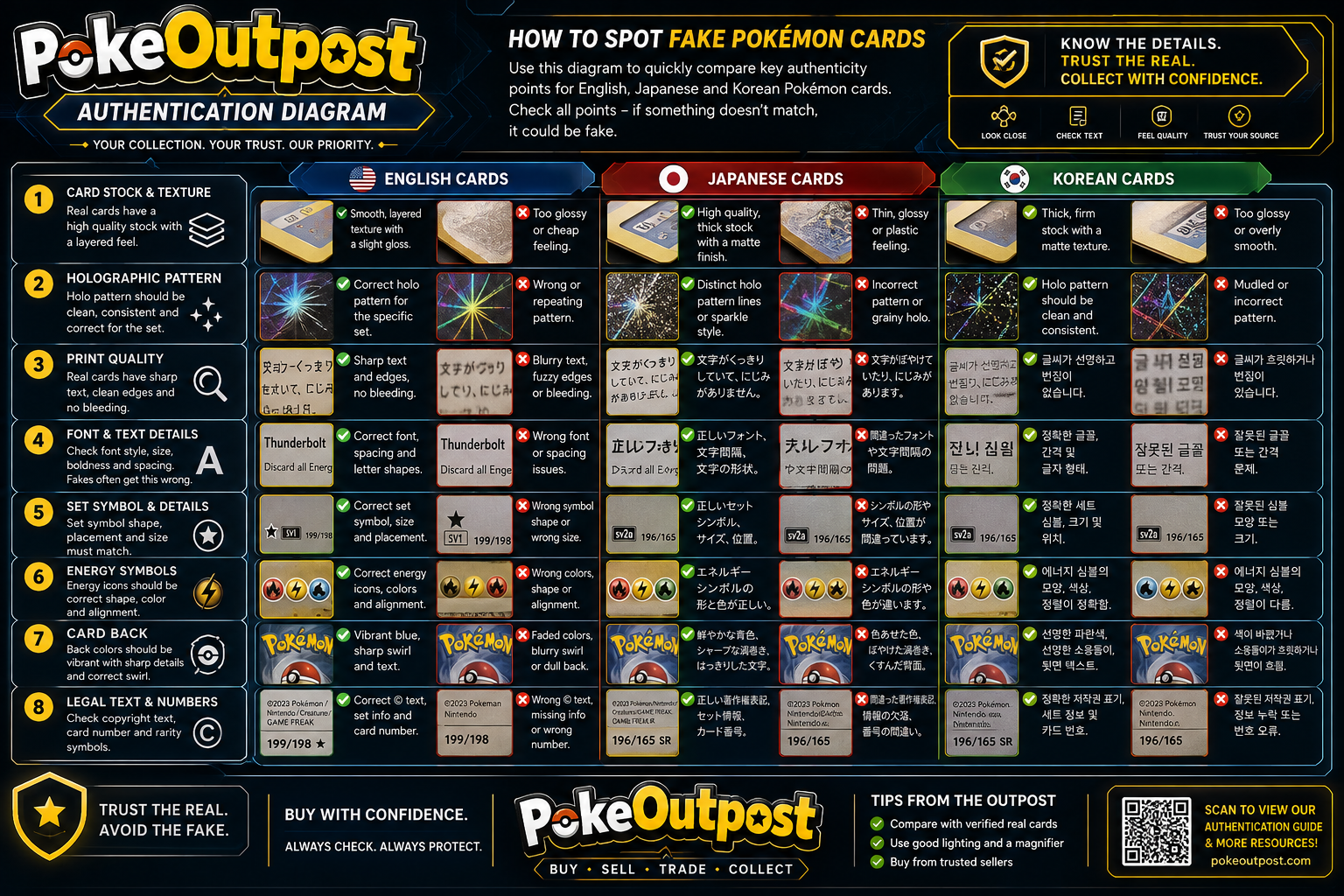
First determine which regional version you are examining. English, Japanese and Korean Pokémon cards can have different layouts, typography, numbering systems, rarity systems and card backs.
English
- English Pokémon names
- English attack text
- English typography
- English regional printing
- Correct English card back
Japanese
- Japanese text
- Japanese typography
- Japanese set characteristics
- Japanese rarity characteristics
- Correct Japanese card back
Korean
- Korean Hangul
- Korean typography
- Korean set characteristics
- Korean rarity characteristics
- Correct Korean reference card
Verify the Exact Card
Counterfeit cards often copy artwork while changing important card information. Verify the exact card rather than simply checking whether the Pokémon exists.
Pokémon Information
- Pokémon name
- Spelling
- HP
- Evolution stage
- Pokémon type
- Card type
- Illustrator
Gameplay Information
- Attack names
- Attack descriptions
- Attack damage
- Energy requirements
- Weakness
- Resistance
- Retreat cost
- Impossible card combination
- Impossible HP
- Incorrect attack
- Incorrect Energy requirement
- Incorrect weakness/resistance
- Incorrect artwork
Set, Collector Number & Rarity
Verify that the exact combination of Pokémon, artwork, set, collector number and rarity exists.
| Check | Verify | Warning Sign |
|---|---|---|
| Set | Does this card belong to this set? | Impossible combination |
| Number | Does the collector number exist? | Incorrect numbering |
| Rarity | Was this exact card printed at this rarity? | Impossible rarity |
| Artwork | Does the artwork match the version? | Artwork from another version |
| Foil | Is the foil treatment correct? | Incorrect foil |
Physical Examination
Dimensions
Compare width, height, thickness and corner shape against a suitable genuine reference.
Card Stock
Compare
- Stiffness
- Thickness
- Surface finish
- Flexibility
- Overall feel
Warning Signs
- Plastic-like feel
- Unusual thinness
- Unusual thickness
- Unusual gloss
- Major difference from reference
Edges
- Check the cut quality.
- Look for rough fibres.
- Look for cardboard residue.
- Check consistency around the card.
- Compare against a genuine card.
Corners
- Check all four corners.
- Compare the corner radius.
- Look for uneven cutting.
- Look for unusual damage or fibres.
Printing & Typography
Typography
- Font
- Font weight
- Font size
- Letter spacing
- Line spacing
- Text alignment
Printing
- Sharpness
- Ink density
- Colour consistency
- Print registration
- Artwork resolution
- Ink bleeding
Energy Symbols
Compare Energy symbol shape, size, clarity, spacing and position with a genuine reference.
Copyright & Legal Text
- Check wording.
- Check printing clarity.
- Check applicable copyright information.
- Compare against the exact card version.
Card Back Examination
Compare the back of the suspected card with a known genuine card from the same regional version.
- Overall colour
- Blue border
- Poké Ball
- Pokémon logo
- Swirl design
- Border sharpness
- Print registration
- Washed-out colour
- Incorrect blue
- Blurry logo
- Incorrect proportions
- Severe print misalignment
Holographic & Textured Cards
Modern Pokémon cards can use holographic, etched and textured finishes. Always compare the exact card version.
- Holo pattern
- Texture
- Texture direction
- Foil placement
- Reflectivity
- Texture density
- Generic-looking foil
- Incorrect pattern
- Missing texture
- Texture in wrong location
- Incorrect shine
Magnification
A loupe or digital microscope can reveal printing characteristics that are difficult to see with the naked eye.
- Text edges
- Printing dots
- Ink registration
- Energy symbols
- Artwork
- Border printing
- Copyright text
- Holofoil
- Texture
Light Test
Holding a card against a bright light can provide additional information about card construction.
Compare
- Amount of light passing through
- Overall opacity
- Consistency
- Behaviour against a genuine reference
Weight
A precision scale can provide additional evidence, but weight should never be used as a standalone authentication method.
English, Japanese & Korean Comparison
English
- English text
- English typography
- English card back
- Correct regional references
Japanese
- Japanese text
- Japanese typography
- Japanese set references
- Japanese card back
Korean
- Korean Hangul
- Korean typography
- Korean set references
- Genuine Korean reference
Seller & Source Checks
- Established retailer
- Receipt available
- Traceable supplier
- Reasonable market price
- Clear purchase history
- Extremely low price
- Large quantity of rare cards
- Unknown source
- No purchase history
- Suspicious packaging
Sealed & Resealed Products
A sealed product may be counterfeit or it may be a genuine product that has been opened and resealed.
Packaging
- Correct product name
- Correct artwork
- Correct Pokémon branding
- Correct set information
- Correct spelling
- Correct grammar
- Correct logos
- Correct product information
Shrink-Wrap
- Inspect material.
- Inspect seams.
- Inspect folds.
- Check tension.
- Look for signs of opening.
- Compare with genuine packaging.
Booster Packs
- Check artwork.
- Check text.
- Check seals.
- Check seal edges.
- Check for unusual construction.
- Compare with a known genuine pack.
Tests PokeOutpost Does Not Recommend
High-Value Card Procedure
- Photograph front
- Photograph back
- Record source
- Verify exact card
- Verify set
- Verify collector number
- Verify rarity
- Verify artwork
- Check card back
- Check dimensions
- Check card stock
- Check edges
- Check corners
- Check typography
- Check Energy symbols
- Check copyright
- Check holo
- Check texture
- Magnification inspection
- Genuine-reference comparison
- Record final decision
STOP & INVESTIGATE Indicators
- Card does not appear to exist
- Impossible set/card combination
- Impossible rarity
- Incorrect card back
- Major font mismatch
- Major spelling errors
- Impossible HP
- Incorrect attack information
- Incorrect Energy symbols
- Incorrect collector number
- Incorrect artwork
- Incorrect holo
- Incorrect texture
- Major card-stock difference
- Severe cutting abnormalities
- Suspicious sealed packaging
- Multiple abnormalities
PokeOutpost Staff Authentication Procedure
| Stage | Action | Decision |
|---|---|---|
| 1 | Identify language and card | Continue / Investigate |
| 2 | Verify exact card online | Continue / Hold |
| 3 | Compare genuine reference | Continue / Hold |
| 4 | Physical examination | Continue / Hold |
| 5 | Magnification inspection | Continue / Escalate |
| 6 | Final assessment | Genuine / Suspicious / Counterfeit |
Recommended Authentication Equipment
- Bright inspection light
- Smartphone camera
- 5×–10× loupe
- Digital microscope
- Precision ruler
- Digital calipers
- Precision scale
- Clean inspection mat
- Known genuine reference cards
- Genuine sealed reference products
- Card sleeves
- Authentication records
Complete Authentication Checklist
- Correct language
- Card exists
- Correct Pokémon name
- Correct HP
- Correct attacks
- Correct Energy symbols
- Correct weakness
- Correct resistance
- Correct retreat cost
- Correct artwork
- Correct illustrator
- Correct set
- Correct collector number
- Correct rarity
- Correct foil treatment
- Correct typography
- Correct copyright
- Correct card back
- Correct colour
- Correct dimensions
- Correct thickness
- Correct card stock
- Clean edges
- Correct corners
- Holo checked
- Texture checked
- Magnification completed
- Light comparison where appropriate
- Weight checked where appropriate
- Compared with genuine reference
- Seller/source checked
- Final result recorded
Authentication Result
APPEARS GENUINE
No significant counterfeit indicators were identified during the examination.
SUSPICIOUS — HOLD
One or more characteristics require further investigation. Do not purchase or list until resolved.
COUNTERFEIT
Multiple independent characteristics indicate that the item is not authentic.